
Electrical Engineering
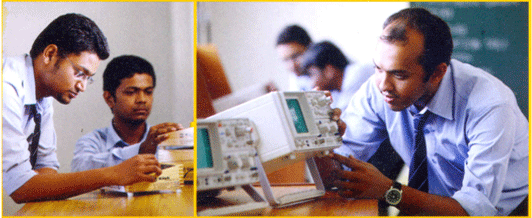
The Department of Electrical Engineering was established in 2010 with intake capacity 60 students. The Department has seen nice growth in all aspects. The department has well equipped laboratories with modern and sophisticated equipments. The various laboratories are Electrical Machines Lab, High Voltage Lab, Basic Electrical Engg. Lab, Network Analysis Lab, Switchgear and Protection Lab, Control System Lab, Electrical Engg. Workshop Lab and Power Electronics Lab.
Electrical Department has very vibrant student’s forum (ELECTRA) which organizes co-curricular and extracurricular activities for bringing out the hidden talents of students.
Key Strengths
- Well qualified and experienced faculty rich in Industrial and Teaching experience.
- Guest lecturers are invited from eminent personalities in industries and research foundations & workshops in various areas of expertise.
- Access to Internet for students and staff through 50 Mbps leased line.
- Effective teaching learning process is implemented by schemes like Class Teacher scheme, continuous assessment of students etc.
- Students are encouraged for vocational training in industries.
Department organizes industrial visits every semester in - Electrical Field areas such as Chandrapur Super Thermal Power Station, Area Load Dispatch Center, Ambazari, Koradi and Khaparkheda Thermal Power Station, Pench Hydro-electric Power Station etc.
Teaching Scheme
Syllabus
Academic Calendar
VISION:
To evolve as a center of excellence for imparting knowledge in Electrical Engineering aimed at bringing out globally competent Electrical Engineers, Researchers, and Entrepreneurs with values.
MISSION:
- To provide state-of-the-art resources to achieve excellence in teaching-learning, research and development activities
- To provide suitable forums to enhance the creative talents of students and faculty members.
- To bridge the gap between industry and academia by conducting training programs based on industrial and societal needs
- To provide exposure for start-ups and research

Prof Vipin Jais
Designation :- H.O.D. Electrical Engineering Department
Contact No:-
Email id:-
Qualification :-
Teaching Experience :
Industry Experience :
Approved by RTMNU,Nagpur (Nagpur University)
From The Head Of The Department
On behalf of our students and faculty, it is my privilege to welcome all of you to the Department of Electrical Engineering at GWCET. We take pride in our faculty, a team of capable and dedicated professionals, most of whom have academic and industrial experience and degrees from leading colleges of the Maharashtra. We provide ample opportunities to our faculty and students, through in -house trainings, workshops and trainings outside the college campus for further growth and development in their areas of expertise. We at Electrical Department are committed with the following objectives: • The Department has taken up the task of developing competent Electrical engineers of good quality, capable of facing various challenges of the power situation in the country. • To produce graduates with the necessary background and scientific skills to work professionally in several fields in particular with IT Industries and Power sectors. • To train and encourage the graduates for personal and professional success with awareness and commitment to their ethical and social responsibilities, both as individuals and in team environments. • Prepare and train the graduates who are proficient of maintaining and improving their technical competence through enduring, learning, including entering and succeeding in an advanced degree program in a field of Science & Technology. • We are actively involved in research and published several research papers in national, International Journals and Conferences by our staff and students. We incorporate stronger ethical and enterprising values in our academics to face new challenges in the area of Electrical Engineering.
News & Updates
Prof Vipin Jais

Prof Rajesh Srivastava

Prof Chetan Bhale
Prof Nutan Moghe

Prof Priti Bhange
Programme Outcomes (PO’s)
Engineering Graduates will be able to:
PO1. Engineering Knowledge: Apply the knowledge of mathematics, science, engineering fundamentals, and an engineering specialization to the solution of complex engineering problems.
PO2. Problem Analysis: Identify, formulate, review research literature, and analyze complex engineering problems reaching substantiated conclusions using first principles of mathematics, natural sciences, and engineering sciences.
PO3. Design/development of solutions: Design solutions for complex engineering problems and design system components or processes that meet the specified needs with appropriate consideration for the public health and safety, and the cultural, societal, and environmental considerations.
PO4. Conduct investigations of complex problems: Use research-based knowledge and research methods including design of experiments, analysis and interpretation of data, and synthesis of the information to provide valid conclusions.
PO5. Modern tool usage: Create, select, and apply appropriate techniques, resources, and modern engineering and IT tools including prediction and modeling to complex engineering activities with an understanding of the limitations.
PO6. The engineer and society: Apply reasoning informed by the contextual knowledge to assess societal, health, safety, legal and cultural issues and the consequent responsibilities relevant to the professional engineering practice.
PO7. Environment and sustainability: Understand the impact of the professional engineering solutions in societal and environmental contexts, and demonstrate the knowledge of, and need for sustainable development.
PO8. Ethics: Apply ethical principles and commit to professional ethics and responsibilities and norms of the engineering practice.
PO9. Individual and team work: Function effectively as an individual, and as a member or leader in diverse teams, and in multidisciplinary settings.
PO10. Communication: Communicate effectively on complex engineering activities with the engineering community and with society at large, such as, being able to comprehend and write effective reports and design documentation, make effective presentations, and give and receive clear instructions.
PO11. Project management and finance: Demonstrate knowledge and understanding of the engineering and management principles and apply these to one’s own work, as a member and leader in a team, to manage projects and in multidisciplinary environments.
PO12. Life-long learning: Recognize the need for, and have the preparation and ability to engage in independent and life-long learning in the broadest context of technological change.
Programme Specific Objective (PSO’s)
At the end of the program, the students will be able to:
PSO1: Analyse, design, create Electrical Systems and use associated software’s to improve performance of Electrical Systems.
PSO2: Associate the learning and deal with real world problems in electrical engineering and arrive at optimal solution.
Programme Educational Objectives (PEOs)
The Graduates of Computer Science & Engineering will be able to
PEO 1: Apply concepts of various courses & acquire knowledge of various emerging trends in Electrical Engineering
PEO 2: Design, develop & implement various interdisciplinary and innovative systems.
PEO 3: Inculcate effective communication skills, team work, ethics, and leadership in preparation for a successful career in industry and R&D organizations.